Back to Journal
Offshore Team vs In-House Hiring | Which Is Better?
Reading Time
4 Mins
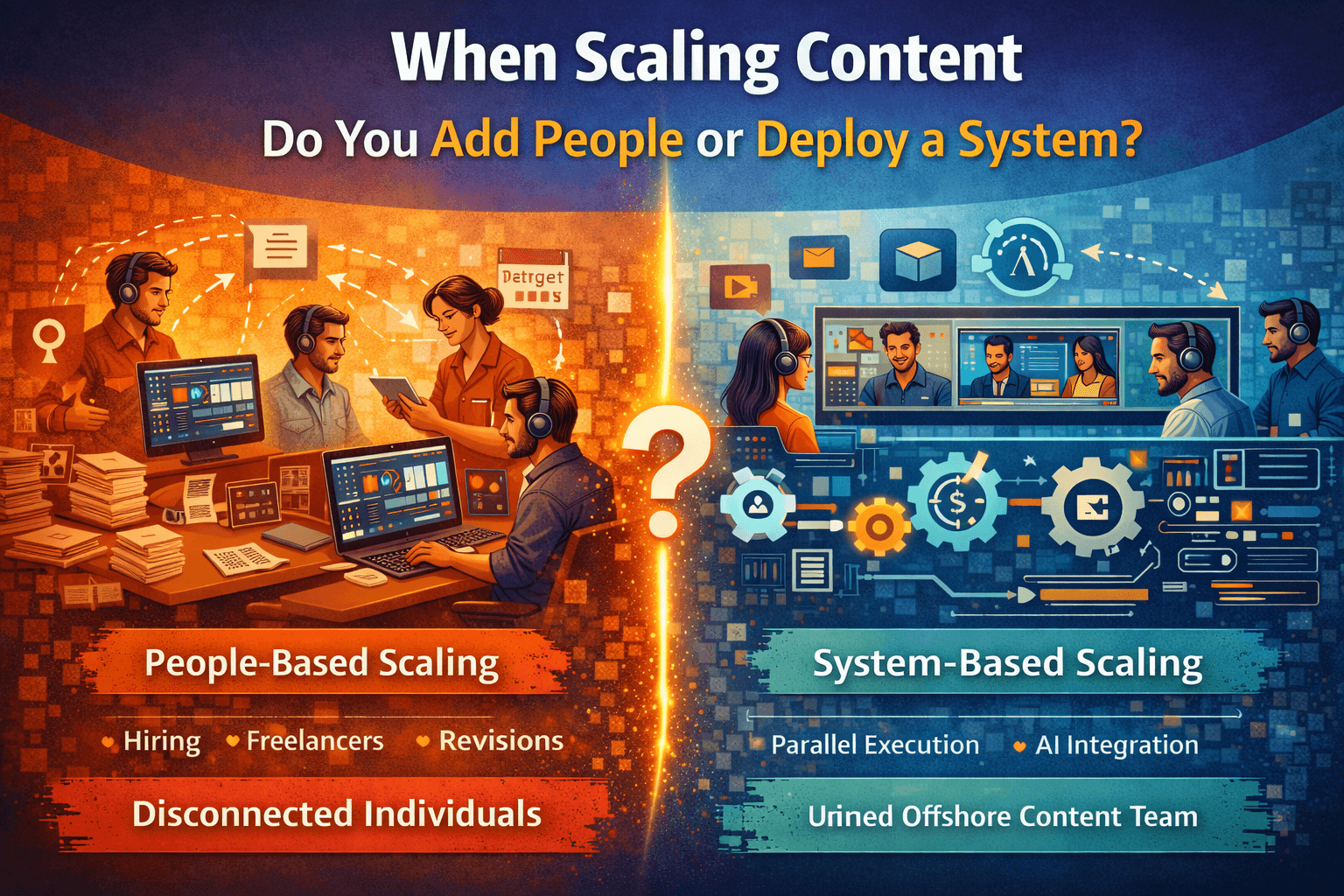
As businesses grow, they inevitably reach a critical decision point—how to scale their operations effectively. Increased demand brings more projects, tighter deadlines, and a constant need for higher output. At this stage, many companies instinctively turn to hiring more employees, assuming that expanding the in-house team is the most logical way forward.
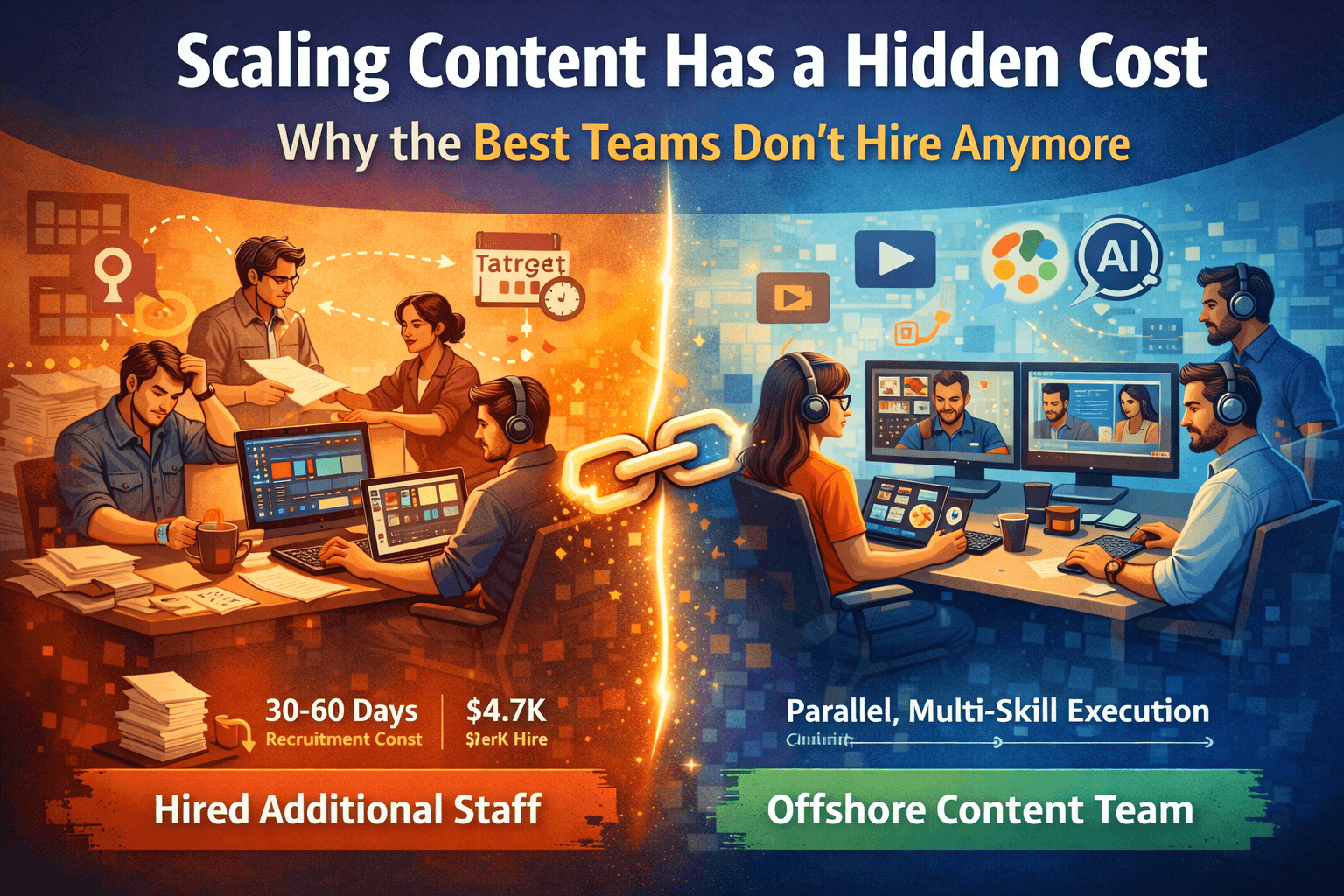
Initially, this approach works. More hands on deck mean more work gets done. But as the business continues to scale, cracks begin to appear. Hiring becomes slower and more expensive, operational complexity increases, and despite adding more people, output doesn’t grow at the same pace.
This is where the traditional model starts to fall short.
As a result, more businesses are now evaluating offshore teams vs in-house hiring—not just from a cost perspective, but as a strategic decision to improve scalability, efficiency, and long-term growth.
The Traditional Approach: Hiring In-House
Hiring works well—up to a point.
You get:
direct control
team alignment
immediate communication
But it comes with trade-offs:
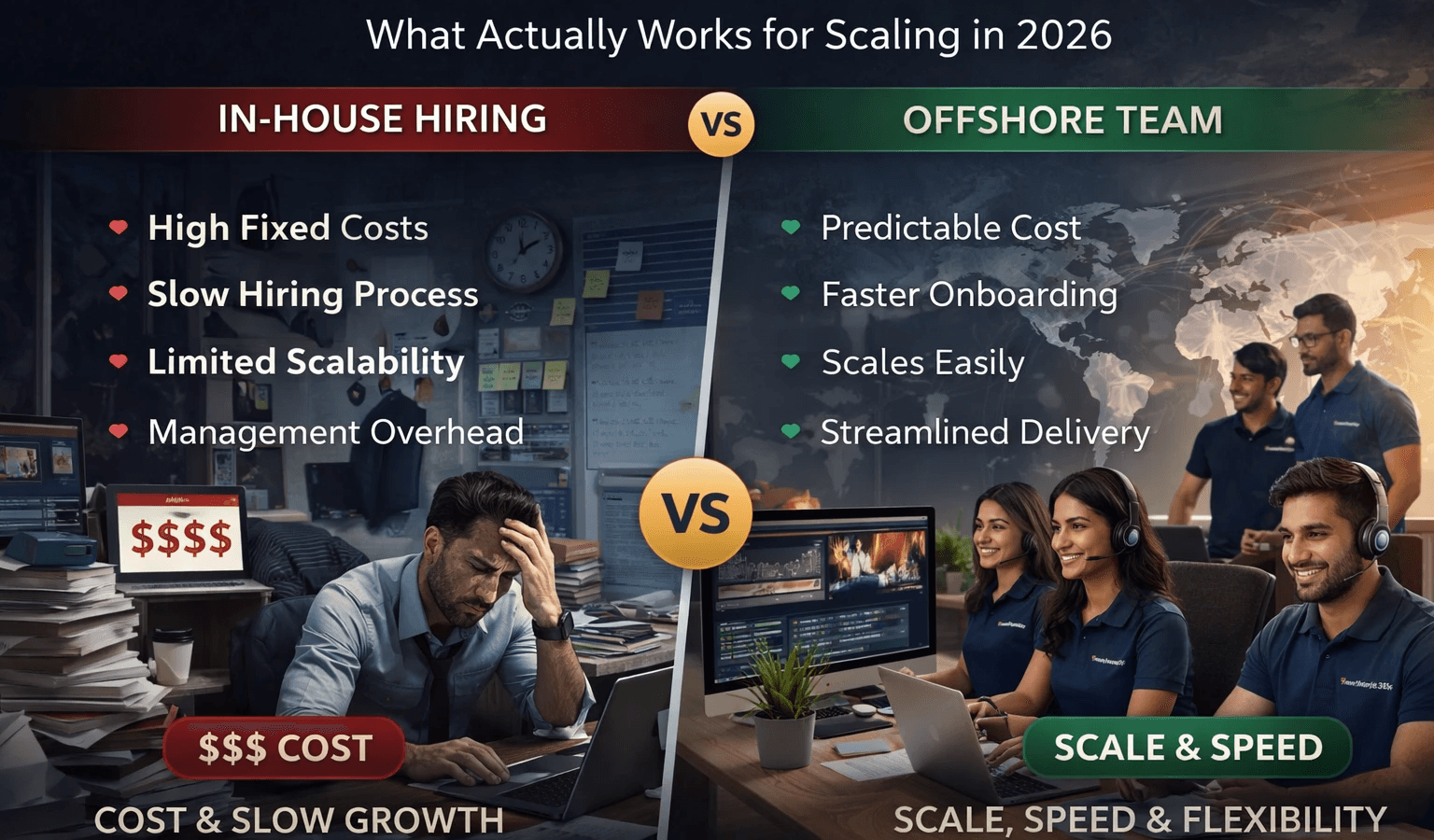
high fixed costs
long hiring cycles
limited flexibility
management overhead
For small teams, this is manageable.
For scaling businesses, it becomes a bottleneck.
The Modern Approach: Offshore Teams
Offshore teams are built differently.
Instead of hiring individuals, you get:
a group of specialists
structured workflows
scalable output
And most importantly:
👉 You gain capacity without complexity
Offshore Team vs In-House Hiring (Full Comparison)
Factor | In-House Hiring | Offshore Team |
|---|---|---|
Cost | High fixed salaries | Predictable monthly cost |
Hiring Time | 4–8 weeks | 1–2 weeks |
Skill Coverage | Limited | Multi-specialist team |
Scalability | Slow | Fast and flexible |
Output | Linear growth | Scalable production |
Risk | High (bad hire) | Lower (team-based model) |
Management | High | Low |
👉 The key difference:
In-house hiring scales linearly
Offshore teams scale exponentially
Cost Comparison (Real Numbers)
Let’s look at a realistic scenario:
In-House:
1 video editor: $100K/year
Add motion designer + designer → $200K+
Offshore Team:
3–5 specialists
$54K–$87K/year equivalent
👉 You’re not just saving money—you’re increasing output per dollar.
When In-House Hiring Makes Sense
To be clear, hiring isn’t wrong.
It works best when:
you need deep internal ownership
roles are highly strategic
work is consistent and predictable
When Offshore Teams Are the Better Choice
Offshore wins when:
you need to scale quickly
output demand is high
hiring is too slow or expensive
you want flexibility
The Hybrid Model (What Smart Companies Do)
The most effective companies don’t choose one or the other.
They combine both.
In-House Team:
strategy
leadership
decision-making
Offshore Team:
execution
production
scaling output
👉 This is the model that delivers the best results.
Common Mistakes to Avoid
❌ Treating Offshore as “Cheap Labor”
This leads to poor quality.
❌ Hiring Too Late
Teams burn out before scaling.
❌ No Process
Even great teams fail without structure.
Most businesses compare:
👉 “Which is cheaper?”
The better question is:
👉 “Which helps us grow faster?”
Because growth comes from:
speed
consistency
output
And this is where offshore teams have the advantage.
The debate between offshore team vs in-house hiring isn’t about replacing one with the other.
It’s about building a system that supports growth.
The companies scaling fastest today aren’t choosing—they’re combining both.
And using offshore teams to remove execution bottlenecks.
Want to scale your team without increasing your hiring burden?
Build a dedicated offshore creative team that integrates with your workflow and delivers consistent, high-quality output.