Back to Journal
Adapt Offshore or Fall Behind | Scale Without Hiring
Reading Time
2 Min
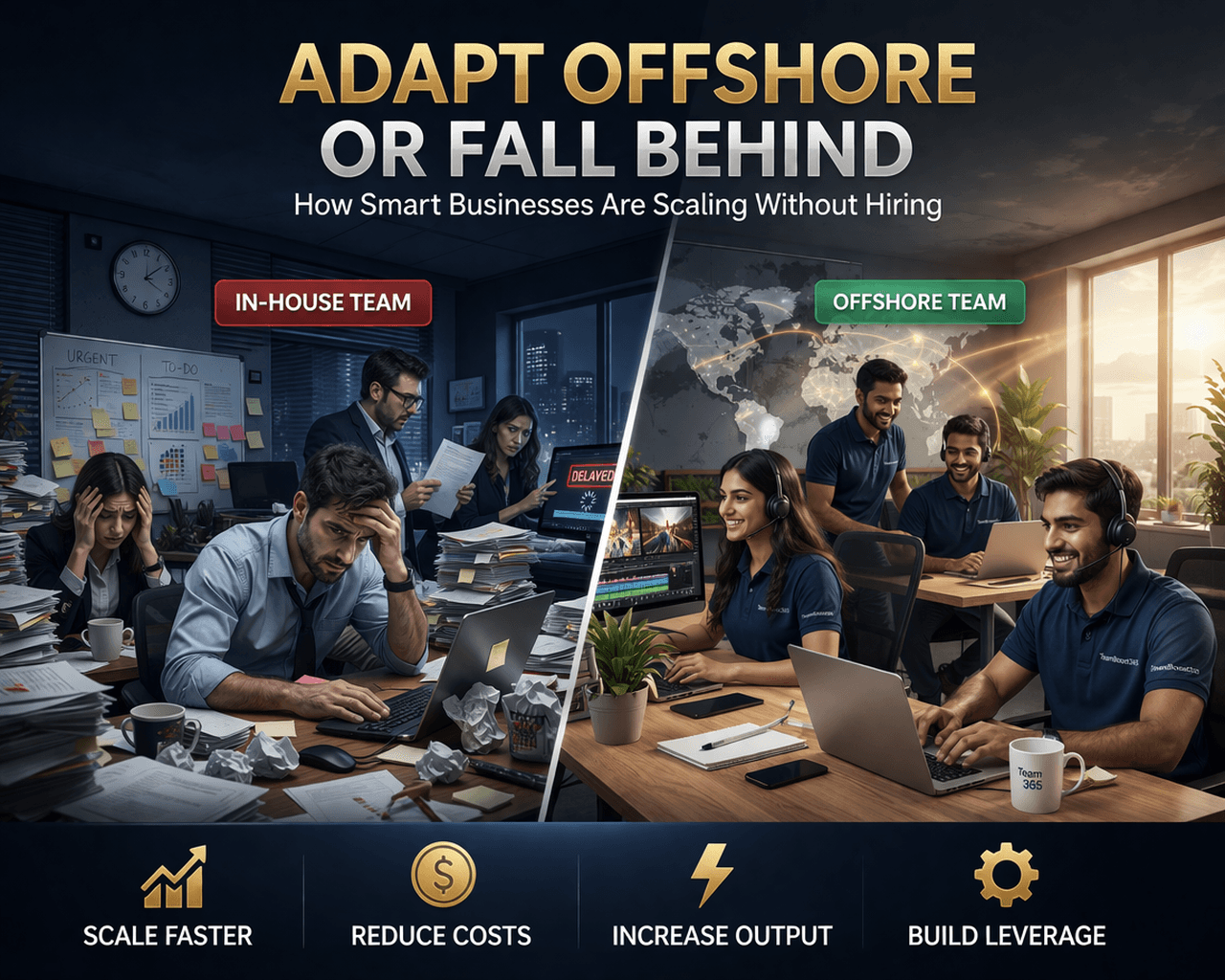
Businesses today aren’t struggling with ideas—they’re struggling with execution.
As demand for content, design, and video continues to grow, in-house teams are hitting their limits. Hiring more people seems like the obvious solution, but rising costs, long recruitment cycles, and operational complexity make it harder to scale.
That’s why more companies are turning to offshore teams for business growth—a smarter way to increase output, reduce overhead, and stay competitive without expanding headcount.
The real shift isn’t about outsourcing tasks.
It’s about building systems that allow your business to scale efficiently.
The Problem: Growth Is Outpacing Teams
If you’re scaling a business, this probably sounds familiar:
Your team is constantly busy
Projects take longer than expected
Content production is inconsistent
Hiring takes too long
The traditional solution is to hire more people.
But hiring comes with its own problems:
High costs
Long recruitment cycles
Limited flexibility
Management overhead
At some point, adding more people stops solving the problem.
The Shift: From Hiring People to Building Systems
The companies growing fastest today aren’t just hiring more.
They’re building systems that allow them to scale output without scaling complexity.
This is where offshore teams come in.
Instead of relying on one person for one role, you get:
multiple specialists
structured workflows
scalable capacity
👉 It’s not just outsourcing—it’s operational leverage.
Why Offshore Teams Are Becoming the Default
1. Cost Efficiency Without Compromise
Hiring one in-house editor can cost:
$96K–$132K/year fully loaded (BLS data)
An offshore model can provide multiple specialists for comparable or lower cost.
2. Speed and Scalability
Need more output?
Instead of hiring (which takes months), you can scale your team quickly.
3. Reduced Operational Burden
No:
recruitment
HR management
benefits administration
Your team focuses on output—not overhead.
4. Real-Time Collaboration
Modern offshore teams:
work in your time zone
join your calls
use your tools
The experience feels in-house.
Hiring vs Offshore Teams (Reality Check)
Factor | Hiring In-House | Offshore Team |
|---|---|---|
Cost | High | Optimized |
Hiring Time | Slow | Fast |
Scalability | Limited | Flexible |
Output | Linear | Scalable |
Risk | High (bad hire) | Lower (team model) |
Management | High | Low |
👉 The difference is simple:
Hiring increases cost.
Offshore increases capacity.
The Biggest Misconceptions About Offshore Teams
❌ “Offshore means low quality”
Reality: Quality depends on process, not location.
❌ “Communication is difficult”
Reality: The right teams work in your timezone and integrate fully.
❌ “It’s risky”
Reality: Hiring the wrong person is often riskier than working with a structured team.
What Happens If You Don’t Adapt
This is where most businesses underestimate the risk.
If you stay fully in-house:
your costs continue to rise
your output stays limited
your team gets burned out
your competitors move faster
And over time, the gap widens.
Not because they’re better—but because they’re more efficient.
What Adapting Offshore Actually Looks Like
It’s not about replacing your team.
It’s about extending it.
A modern offshore setup looks like:
your internal team focuses on strategy
your offshore team handles execution
both operate as one unit
This is how you scale without losing control.
The Real Advantage: Leverage
Offshore teams don’t just save time or money.
They give you leverage.
More output without more hiring
Faster execution without chaos
Scalable growth without burnout
The businesses that win in the next few years won’t be the ones with the biggest teams.
They’ll be the ones with the smartest systems.
Adapting to offshore isn’t a shortcut.
It’s a shift in how modern businesses operate.
And the earlier you make that shift, the bigger the advantage.
Want to scale your output without increasing your headcount?
Build a dedicated offshore creative team that works in your timezone, integrates with your workflow, and delivers consistent, high-quality results.